We didn't set out to own three Moka pots. They arrived one at a time over the years, each for a reason that made sense on the day. We're down to two now, and how we lost the third is a small and slightly annoying story in its own right.
Our coffee habit came with my husband. He was already a committed Bialetti Moka pot owner, and before long I was converted too.
The little pot that has barely changed
The Moka pot is one of those designs that got it right early and then mostly left it alone. Bialetti has been making the octagonal aluminium Moka Express since the 1930s, and the classic one we had looked near enough identical to the ones people were using decades ago.
The eight-sided body isn't there to look pretty. It helps the metal spread the heat and gives you something to grip. Water in the bottom, ground coffee in the middle, and as it heats the pressure pushes the coffee up into the top chamber. No pods, no electronics, nothing that can really break.
That simplicity is the whole point, and it's why they last the way they do.
How one became three, and back to two
The first pot came from before us. My husband had it when we met, and it went on to give, at a rough count, more than twenty years of service. For most of that it was the everyday pot, used without a second thought, the way you use a kettle.
Then we moved into this house five and a half years ago and had an induction hob for the first time. The classic aluminium pot won't work on induction, so we bought the six-cup Moka Induction to take over on the new hob. Rather than retire the old one, we moved it into the camping box, where it earned a few more years over a gas flame on campsites.
A good second career for a pot already in its twenties.
What finished it off wasn't the pot. It was us. We've quietly given up camping, cleared out the tent and most of the kit, and somewhere in that clear-out the old Moka pot went with it. I went looking for it to photograph for this piece and it isn't anywhere, which means I've thrown out a coffee pot that had given more than twenty years and still worked.
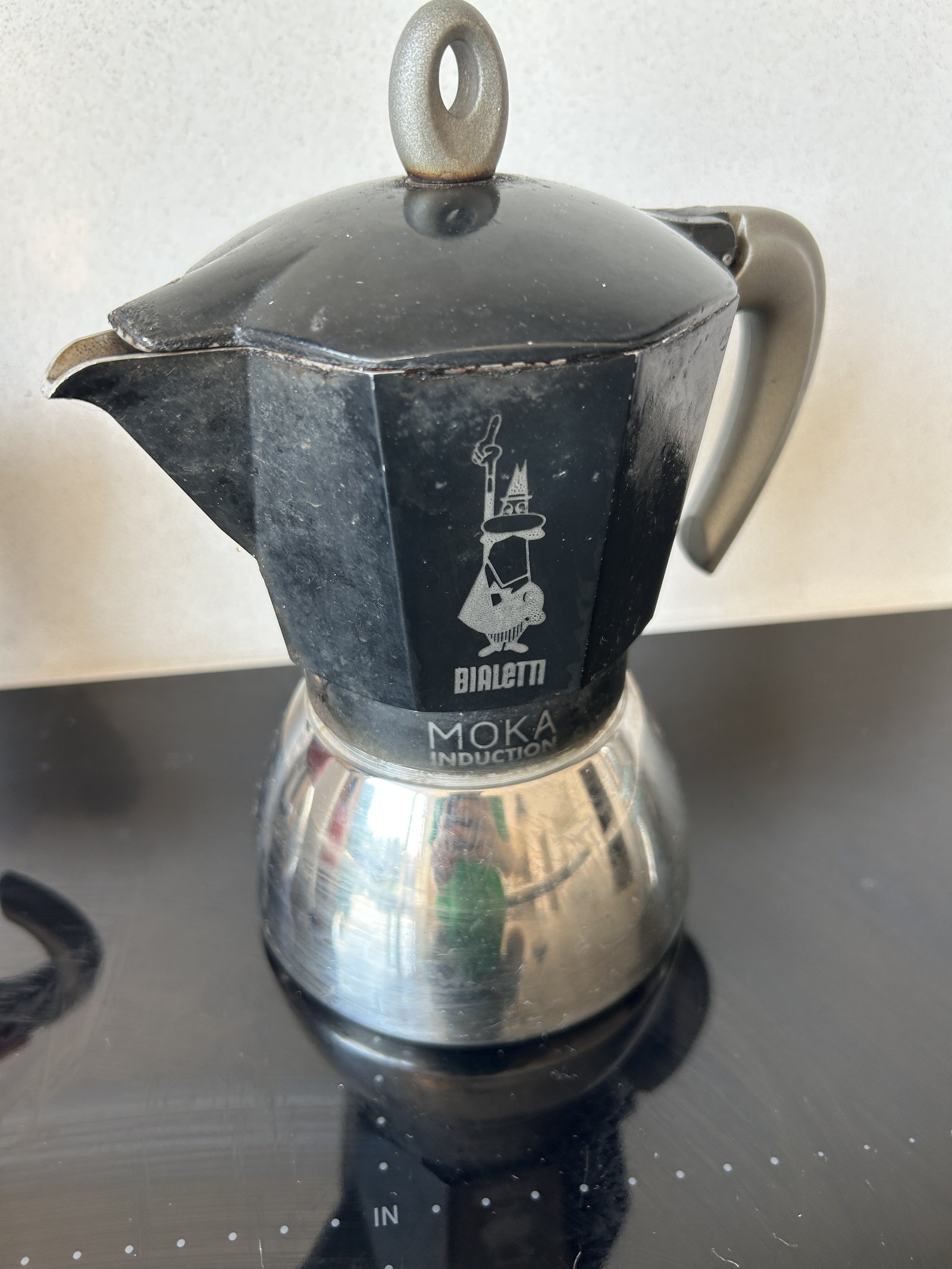
The six-cup, our breakfast pot, wearing its years honestly
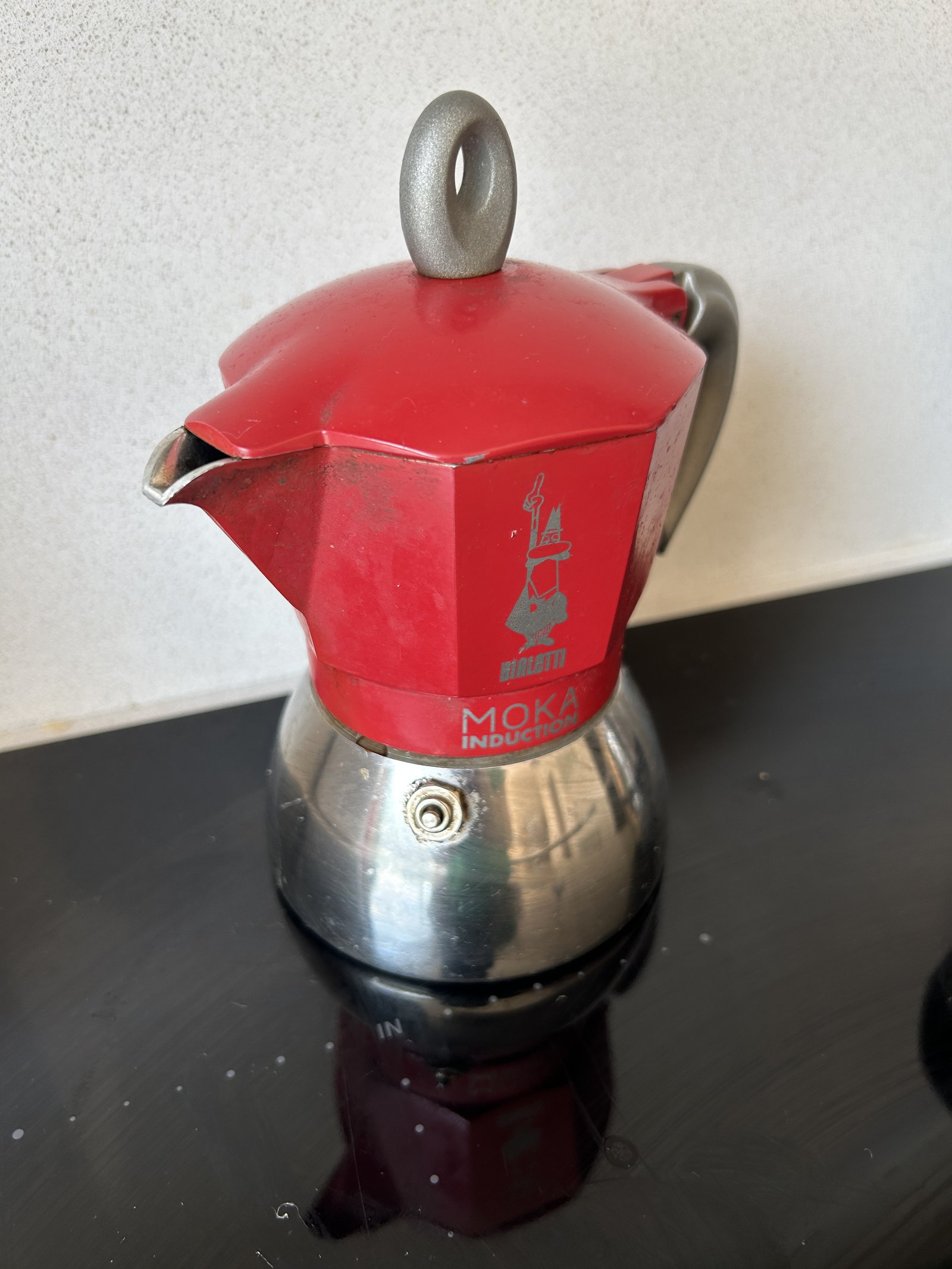
The two we do still have are both the Induction version. The six-cup does breakfast for me, my husband and our daughter, who's recently acquired a coffee habit, and the four-cup does the mid-morning cup for one person on a working-from-home Tuesday. Between them they cover how we actually drink coffee.
Across all of them, over all those years, nothing ever went wrong mechanically. The only thing that ever builds up is limescale, which comes with living in a hard water area.
The one thing worth knowing before buying
If you have an induction hob, check the pot before you fall for the classic. The traditional aluminium Moka Express won't work on induction at all, because aluminium isn't magnetic. That's the entire reason we ended up on the Induction range. Bialetti makes a version with a steel base built in for exactly this.
Why it's still the Moka pot
The Moka pot has never been the only way we make coffee. We've got two cafetières, a big one and a small one, that still come out now and then. I actually prefer the little one, which was a present, for an afternoon cup when I don't want a strong espresso coffee.
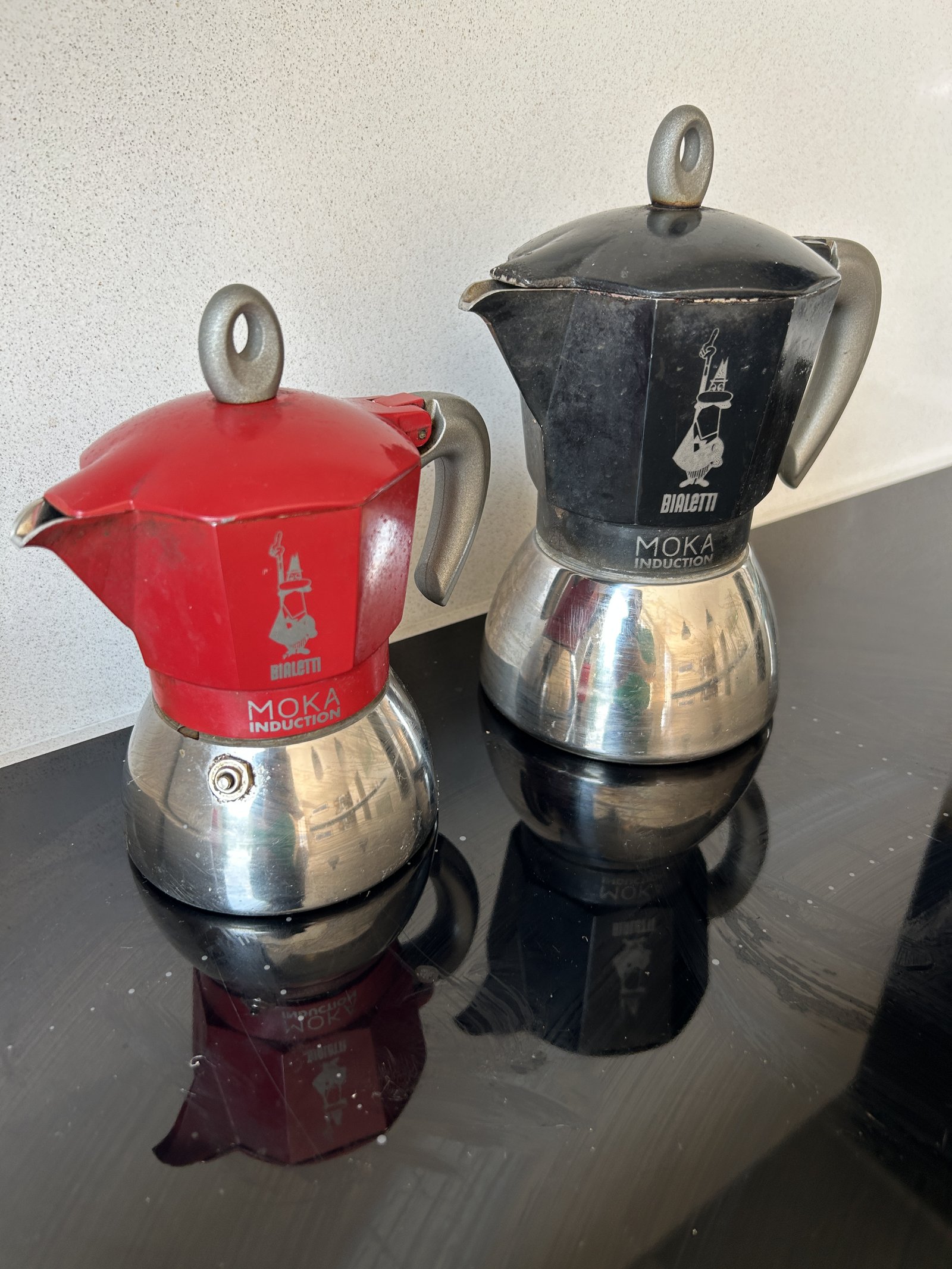
The red four-cup, the mid-morning one
And for a good while we had a Jasper Morrison filter machine for Kenwood that we genuinely loved, and that did a lot of the after-dinner coffee when friends were round. A lovely-looking thing. It also leaked, which turned out to be a known fault with the design rather than bad luck on our part, and in the end that was that.
What's kept the Moka pot in daily use through all of that is how little there is to it. No paper filters to run out of, no reservoir to leak, no plunger to work loose. It makes strong, consistent coffee and the only thing that can really go wrong is you wandering off and leaving it on the heat too long.
Was it worth it?
I've no idea what my husband paid for the original pot, and the two induction pots were around thirty pounds each, a little less for the four-cup, and even buying both new is a small amount for something you use every single day.
The real spend in home coffee goes elsewhere. It goes on beans over the years, on the grinder that came to us as a present, and on the Lavazza milk frother that turns a decent cup into a reasonable home cappuccino. The thing at the centre of it all is also the cheapest part.
The next chapter
The two induction pots are staying, and on past form they'll be around for a very long time. We're about to move, and for once the hob doesn't matter. The steel base means they work on gas as happily as induction, so whatever the new kitchen has, breakfast and mid-morning coffee carry on unchanged. After years of the pot having to suit the kitchen, it's a small relief to have two that suit any of them.
The original's chapter is closed, not gracefully, but it owed us nothing by the end. The one lesson we've taken from it is daft but real. If something has quietly served you for twenty years, maybe don't let it leave in a bin bag with the tent pegs. And if a Moka pot ever does need anything, it's usually just the rubber seal, which costs a pound or two. Even wearing out is cheap.
Still worth keeping?
- Durability
- Excellent, and then some. The original gave more than twenty years across two different lives and still worked when it left us. Nothing has ever failed mechanically. The only thing that ever beat one of these pots was us throwing it out.
- Design
- Bialetti Moka Express, aluminium, essentially unchanged since the 1930s. The classic works on gas, the Induction version with a steel base works on any hob.
- Would we buy it again?
- Yes. We're on our second and third already, and there'll be a fourth eventually.
- Best for
- Anyone who wants proper stovetop coffee cheaply and doesn't want another appliance that can break.