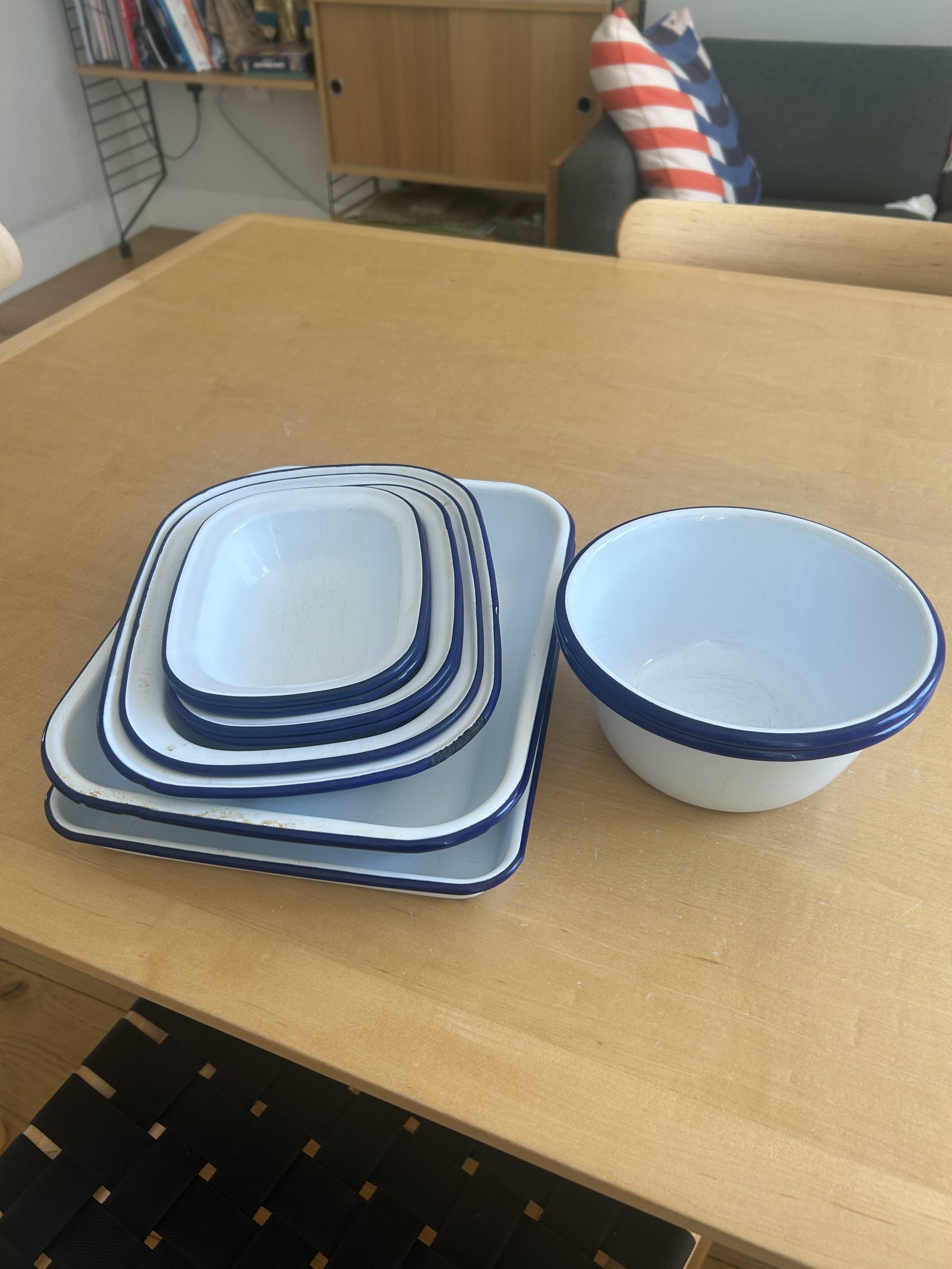
Not everything worth keeping was saved up for. Some of it was an accident.
My husband bought a set of enamelware as a birthday present for someone else, one of those gifts you buy because you think it looks nice, not because you're planning to start a collection. We both liked it enough that we bought ourselves a couple of pieces off the back of it, starting with the big one: the size that's perfect for a lasagne or a fish pie, and the one that comes out whenever we've got people round, because it's exactly right for feeding six.
Then came a holiday to Falmouth. We hadn't gone there to buy kitchenware, but tucked away in the amazing Trago Mills was the biggest display of enamelware either of us had ever seen, and one by one we started picking pieces up. We came home with rather more of it than we'd planned for. Four or five years later, hardly a day goes by without at least one of those dishes being used.
The real benefit isn't the look
It's not a design classic in the Robin Day sense. Nobody's tracing the original drawings or reissuing it from a foundation archive. It's been made in more or less the same form since the 1920s: white porcelain enamel fused onto steel, with a coloured rim, built to survive an oven, a hob, a dishwasher and a cupboard door being slammed on it without complaint.
But the thing that's actually kept it in daily use isn't how it looks. It's that it removes friction. We don't think about which dish to cook in versus which one to serve from. It's the same dish. We don't think about decanting into something "nicer" for the table, or babying it in the dishwasher, or working out where it lives in the cupboard. We just use it, which is precisely the kind of quiet, unglamorous quality that makes something genuinely part of daily life rather than an object we own.
That's really the reason this belongs here. Things Worth Keeping isn't only about the big, saved-up-for pieces. Some of the best examples of things we love to use every day are affordable classics.
What years of actual use looks like
This piece contains affiliate links. We may earn a small commission at no cost to you. It never changes the verdict.
We've ended up with a proper nested run of Falcon's rectangular dishes: five sizes, from the big lasagne-and-fish-pie one down to a small one, plus a round bowl in the same navy rim.
We're not fans of the mugs, so ours has stayed a cooking-and-serving collection rather than growing into full tableware.
The one honest mark against it: it will chip eventually. We've had exactly one chip appear, on one dish, across four or five years of proper daily use. The white enamel comes away at the rim and the steel underneath shows through. It's not really a fault so much as the trade-off for something this hard-wearing everywhere else, and one chip in five years of constant use is the kind of ratio that tells you it's not a weakness worth worrying about.
Was it worth it?
This is the easiest "worth it" we've written about so far, because the numbers make their own case. Individual pieces run from around a fiver to somewhere in the teens depending on size, for something we use literally every day. That's about as good a cost-per-use as anything in the house.
Which is really the point of writing about it at all: worth keeping was never really about price. It's about what actually earns a place in ordinary, everyday life, and the things that do that best are rarely the ones that cost the most.
Still worth keeping?
- Durability
- Excellent: one chip across the whole set after years of daily use
- Versatility
- Genuinely exceptional: oven, air fryer, hob-adjacent, dishwasher, straight to table
- Would we buy it again?
- Yes, without a second thought
- Best for
- Anyone who wants something that looks good on the table